
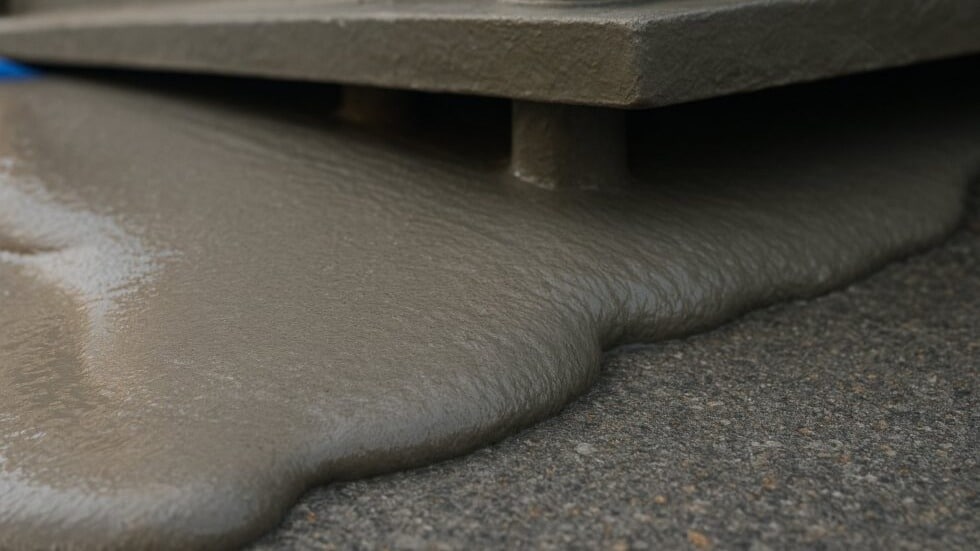
Choosing between epoxy vs cement grout affects equipment alignment, vibration resistance, chemical durability, and long-term maintenance costs. This guide walks through the seven factors that should drive the decision — and when each grout type is the right call.
Choosing between epoxy vs cement grout plays a critical role in stability, alignment, and performance. This decision affects everything from cure time and chemical resistance to long-term durability and maintenance costs.
✨ Looking for our guide on equipment grouting?
Our Equipment Grouting Guide covers all you’ll need to know to get the job done — for both epoxy and cement grout.
Start with Three Critical Questions
When comparing epoxy vs cement grout, start by evaluating these three critical jobsite conditions:
Will the equipment face constant vibration or impact? → Choose epoxy grout – Superior resistance to dynamic loads
Will chemicals contact the base or surrounding concrete? → Choose epoxy grout – Better chemical attack resistance than cement-based options
Will operating temperatures regularly exceed 150°F? → Choose cement grout – Better performance under sustained high heat
Once you’ve answered these questions, the choice between epoxy vs cement grout becomes clearer. After that, select a specific formulation based on your application’s demands — whether that’s flowability, strength, or temperature tolerance.
Compressive Strength: Is Epoxy Grout Stronger Than Cement?
Compressive strength is often the first metric engineers consider when selecting grout for equipment installation. It refers to how much pressure a material can withstand before failing. A grout rated at 14,000 psi, for example, should hold up under that load without crushing.
However, in real-world equipment installations, grout rarely fails because of low compressive strength. While epoxy grouts typically post higher strength ratings, modern cement grouts have narrowed the gap significantly. Some high-performance cementitious products now rival or even exceed epoxy in this category.
Key considerations for grout strength:
- How strength develops over time under actual jobsite conditions
- Temperature effects during curing
- Environmental control during grout placement
- Long-term performance under operating loads
When weighing epoxy vs cement grout strength, don’t focus on lab numbers alone. Consider the complete performance profile for your specific application.
Recommended Products:
Cost: Is Epoxy Grout Worth 3–4x the Price?
The cost difference between epoxy vs cement grout is substantial. Epoxy grouts often cost three to four times more than cement-based options, and specialized formulations can drive costs even higher.
Factors affecting grout costs:
- Material price (epoxy significantly higher)
- Installation complexity
- Cure time (affects project timeline)
- Long-term maintenance requirements
- Replacement costs for premature failure
Because of this cost difference, teams frequently question whether epoxy’s added performance is necessary. In many static or non-aggressive environments, cement grout offers adequate performance at a fraction of the cost.
Best practice: Use epoxy when exposure conditions or dynamic loading justify the premium. Don’t default to epoxy when a properly selected cement grout will perform adequately.
Recommended Products:
Chemical Resistance: Epoxy vs Cement Grout
In installations where equipment contacts chemicals — through operation, cleaning, or accidental spills — grout selection becomes critical for long-term durability.
Epoxy grout advantages:
- Stronger resistance across wide pH range
- Handles acids, alkalis, and solvents
- Non-porous surface resists chemical penetration
Cement grout limitations:
- Susceptible to acid attack
- Porous structure allows chemical penetration
- Limited resistance to aggressive chemicals
Important: Always check the chemical resistance chart for your specific grout. If data doesn’t address your use case, run lab tests under actual site conditions before proceeding.
The cost of chemical-resistant grout is minor compared to damage and downtime from in-service failure.
Recommended Products:
Impact Resistance: Which Grout Handles Dynamic Loads?
Equipment applications involving stamping operations, pump cavitation, or rapid conveyor braking create sudden impact forces. Your grout selection must absorb this energy without cracking or failing.
Epoxy vs cement grout impact performance:
Epoxy grout benefits:
- Low-modulus polymer structure flexes under stress
- Absorbs shock and returns to form without damage
- Superior performance under dynamic loads
Cement grout characteristics:
- Inherently more brittle material
- Handles compressive loads well but poor impact tolerance
- Especially vulnerable in thinner pours
Modified cement options:
- Metallic grouts with metal fillers for increased toughness
- Hybrid grouts combining cement with polymer additives
- Improved impact resistance while maintaining easier handling
Base your grout selection on real operating stress conditions, not just static loading requirements.
Recommended Products:
Vibration Dampening: Protect Equipment and Foundations
Constant vibration gradually damages equipment alignment, reduces bearing life, and compromises concrete foundations. Proper grout selection directly impacts system longevity.
Epoxy grout advantages for vibration control:
- Strong bond to steel baseplates and machinery frames
- Efficient load energy transfer reduces localized stress
- Nearly 100% effective bearing area when properly placed
- Slight flexibility absorbs residual vibration
- Protects both equipment and foundation structure
Cement grout limitations:
- More rigid material transmits vibration
- Lower bond strength to metal surfaces
- Less effective at vibration dampening
For equipment in dynamic environments, epoxy grout’s vibration dampening capabilities often justify the additional cost.
Recommended Products:
Temperature Limits: When Cement Grout Beats Epoxy
Extended high-temperature exposure weakens materials, distorts alignments, and reduces service life. Understanding temperature limits is crucial for grout selection.
Temperature performance comparison:
Epoxy grout limitations:
- Typically rated for continuous exposure up to 150°F
- May soften or lose structural integrity beyond rating
- Performance degrades under combined heat and load
Cement grout advantages:
- Standard formulations handle up to 350°F continuous
- Specialized versions withstand up to 2400°F
- Maintains structural integrity under sustained heat
For high-temperature applications, cement grout is generally the more reliable choice.
Recommended Products:
Flowability and Placement: Which Grout Is Easier to Install?
Proper grout flow under baseplates and into tight clearances ensures full support and long-term performance. Flow characteristics significantly impact installation success.
Cement grout flow properties:
- Uses water and lime for lubricated mix
- Flows easily when properly mixed
- More forgiving during placement
- Better for larger pours
Epoxy grout flow challenges:
- Behaves more like adhesive
- Resists movement and sticks to surfaces
- Complicated placement in low-clearance areas
- Cold temperatures increase viscosity
Installation considerations:
- Factor in ambient temperature
- Consider mixing method requirements
- Account for working time limitations
- Plan placement sequence carefully
Recommended Products:
Application Selection Guidelines
Choose Epoxy Grout When:
- Equipment experiences vibration or impact loading
- Chemical exposure is expected in service
- Fast cure time is project-critical
- Maximum vibration dampening is required
- Premium performance justifies higher investment
Choose Cement Grout When:
- Operating temperatures exceed 150°F (65°C)
- Cost optimization is a primary concern
- Static loading conditions predominate
- Large volume installations are required
- High-temperature resistance is essential
Frequently Asked Questions
What is the difference between epoxy grout and cement grout?
Epoxy grout is a polymer-based grout made from resin and hardener, offering superior chemical resistance, bond strength, and vibration dampening. Cement grout is a cementitious mix of Portland cement, aggregates, and additives, offering better high-temperature performance, easier flowability, and significantly lower cost. Epoxy is typically used for dynamic or chemically aggressive environments, while cement is preferred for static loads, high heat, and large-volume pours.
When should I choose epoxy grout over cement grout?
Choose epoxy grout when equipment will experience vibration, impact loading, or chemical exposure, or when precision alignment is critical. Epoxy grout is the standard for reciprocating compressors, high-speed pumps, stamping presses, and any baseplate installation where dynamic forces or aggressive chemicals would degrade a cement grout over time.
Is epoxy grout always stronger than cement grout?
No, epoxy grout is not always stronger than cement grout. While epoxy typically posts higher compressive strength ratings (often 14,000+ psi), modern high-performance cement grouts can match or exceed those numbers in laboratory conditions. Epoxy’s real advantage is in tensile strength, bond strength to steel, and impact resistance — not raw compressive numbers.
Can I use cement grout in chemical environments?
Standard cement grout has limited chemical resistance and is susceptible to acid attack, alkali damage, and penetration from solvents due to its porous structure. For chemical exposure, epoxy grout or a specialized chemical-resistant cement formulation is recommended. Always verify compatibility against the manufacturer’s chemical resistance chart before specifying.
What is the temperature limit for epoxy grout?
Most epoxy grouts are rated for continuous service temperatures up to 150°F (65°C). Beyond that threshold, the epoxy binder can soften and lose structural integrity, especially under combined heat and load. For sustained high-temperature applications, standard cement grouts handle up to 350°F, and specialized formulations withstand up to 2,400°F.
How much more does epoxy grout cost than cement grout?
Epoxy grout typically costs three to four times more than cement grout on a per-bag basis, and specialty formulations can push that multiplier higher. Total installed cost is often larger still, since epoxy requires more careful placement, tighter temperature control, and shorter working times. That said, epoxy’s longer service life in demanding environments frequently offsets the upfront premium.
Which grout type is easier to install?
Cement grout is generally easier to install. It has more forgiving flow characteristics, longer working times, and is less sensitive to ambient temperature. Epoxy grout behaves more like an adhesive — it resists flow, sticks to tools and surfaces, and thickens quickly in cold conditions, making placement in tight clearances more difficult.
How long does epoxy grout take to cure compared to cement grout?
Epoxy grout typically reaches full mechanical strength within 24 to 72 hours, allowing equipment to be returned to service quickly. Cement grout generally requires 7 days for structural cure and up to 28 days to reach full design strength. When project timelines are tight, epoxy’s faster cure often justifies its higher cost.
What is non-shrink grout, and do I need it?
Non-shrink grout is any grout formulated to maintain its volume during and after curing, ensuring 100% bearing contact under equipment baseplates. Both epoxy and cementitious non-shrink grouts are available. For any precision equipment installation — pumps, motors, compressors, turbines — non-shrink grout is required to prevent voids, misalignment, and premature bearing failure.
Can epoxy grout be used outdoors?
Yes, epoxy grout performs well outdoors and resists moisture, freeze-thaw cycles, and most environmental exposure. However, some epoxy formulations can yellow or chalk under prolonged UV exposure. For outdoor installations with direct sunlight, confirm the specific product is UV-stable or plan for a protective coating.
What is the best grout for pump and motor baseplates?
For most pump and motor baseplate installations, a low-modulus, flowable epoxy grout is the industry standard. It provides the bond strength, vibration dampening, and chemical resistance needed for rotating equipment. For high-temperature pumps or large-volume installations, a high-performance non-shrink cement grout may be more appropriate.
Making the Right Choice: Epoxy vs Cement Grout
The choice between epoxy vs cement grout ultimately comes down to matching material properties to your specific operating conditions, performance requirements, and project constraints. Use epoxy grout for applications involving chemical exposure, vibration, and impact loading where premium performance justifies the higher investment. Choose cement grout for high-temperature environments, cost-sensitive projects, and static loading conditions where reliability and value are paramount.
Success in industrial grout selection comes from understanding real-world operating demands rather than simply choosing the highest-specification product available. Consider total cost of ownership, installation requirements, environmental conditions, and long-term performance expectations when making your final decision between epoxy and cement grout options.
Need help selecting the right grout for your specific application? Contact our technical team for personalized recommendations based on your equipment and operating conditions.
Need Help Choosing the Right Epoxy Grout?
We’re here to answer all of your questions about epoxy grout solutions, product compatibility, and application techniques. Get expert guidance for your specific project needs.